
 Image 1 of 1
PLAYFAIR, John (1748-1819)
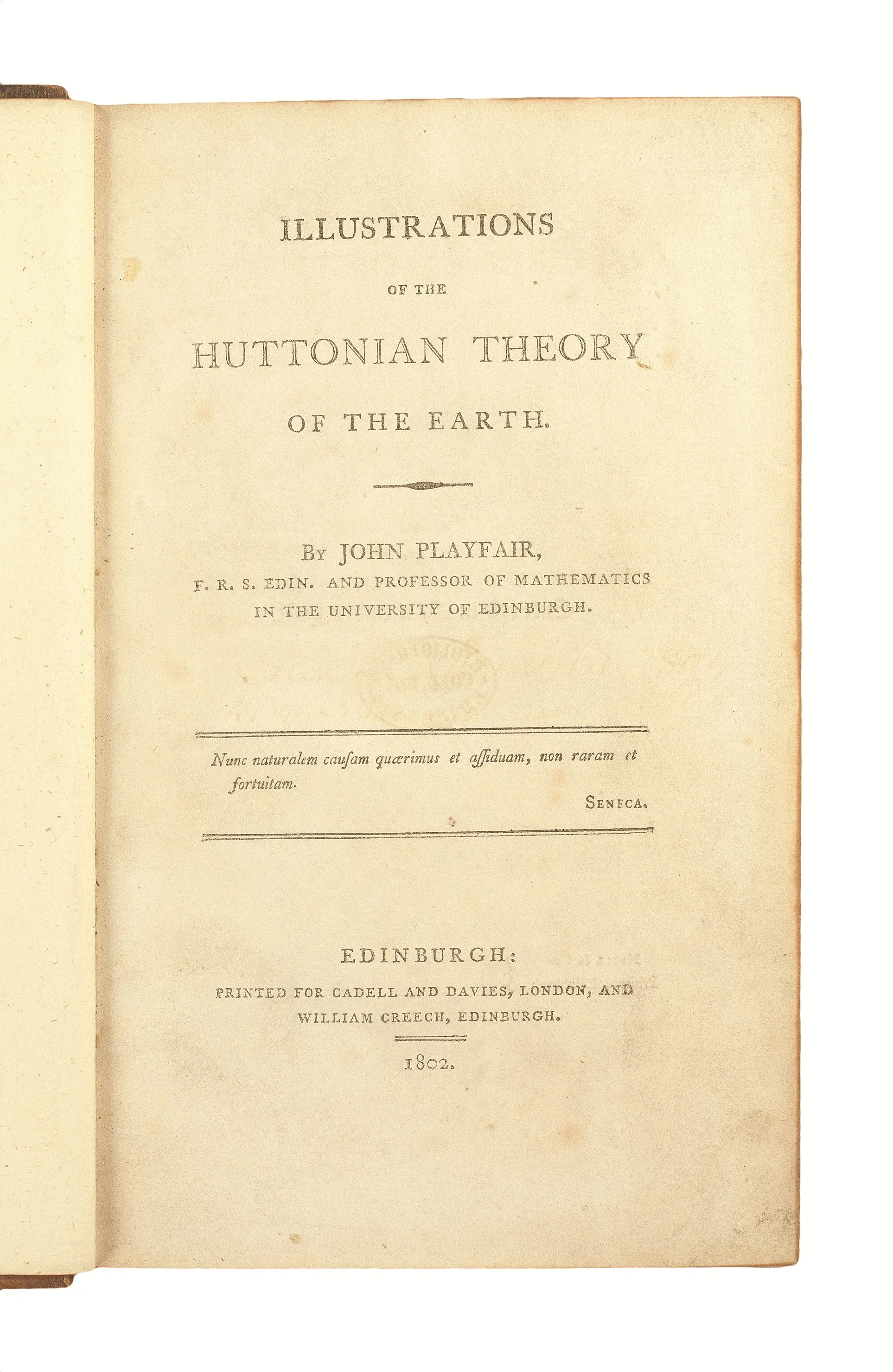
Illustrations of the Huttonian theory of the Earth. Edinburgh: Cadell, Junior, and Davies, London, William Creech, Edinburgh, 1802.
A fine copy of the first edition of Playfair’s ‘well-known masterpiece of geological literature’ (Challinor, p.70). ‘Playfair's principal mathematical work was his Elements of Geometry, 8vo, Edinburgh, 1795... but the work which will always be most prominently associated with his name is the Illustrations of the Huttonian Theory of the Earth, 8vo, Edinburgh, 1802, on which he spent five years. This work is a model of purity of diction, simplicity of style, and clearness of explanation. It not only gave popularity to Hutton's theory, but helped to create the modern science of geology’ (DNB).
Playfair distilled Hutton's theory into three sections taking up the first 140pp. of the present work. Dean (p.103-4) believes that this was derived from two papers delivered to the Royal Society of Edinburgh in 1799. The remainder of the book, some 388pp., is entitled ‘Notes and additions’. From these, Dean (pp.109-114) analyses 26 points by which Playfair directly counters Richard Kirwan's arguments. Moreover, Playfair adds his own modifications to Hutton's theory in this section (cf. Dean pp.115-6). This is important, since it was in Playfair's form that Hutton's theory was mostly digested. Indeed, Gould has suggested Hutton’s theory ‘required Playfair’s recasting to gain acceptability’ (p.63).
For instance, one of Playfair's major changes was to accommodate the idea of extinction, and with it a unique prehistoric past. This latter was bound up with Playfair's insistence that incessant processes, rather than Huttonian cycles, are at work. In other words, Hutton's famous line ‘The result, therefore, of this physical inquiry is, that we find no vesitge of a beginning, - no prospect of an end’ no longer holds true. Hutton argued in both his 1788 paper (p.209) and 1795 book (pp.175-6) that: ‘we have but to examine the strata of our earth, in which we find the remains of animals. In this examination, we not only discover every genus of animal which at present exists in the sea, but probably every species, and perhaps some species with at which at present we are not acquainted... Therefore the system of animal life, which had been maintained in the ancient sea, had not been different from that which now subsists’. In other words, the cyclical nature of the destruction and rebuilding of continents in his physical system also extends into the animal kingdom. Yet this is not the picture of Hutton's theory that been projected over the last 200 years, mainly because Playfair modified this view in Note XXII (p.458 ff.).
Rudwick makes the point that Playfair offered a ‘bowdlerized version that reduced [Hutton’s theory] to a purely mechanical system of physical processes interacting in dynamic equilibrium. This was closely analogous to the dynamic steady state attributed to the Newtonian cosmos’ (pp.465-466).
Dennis R. Dean, James Hutton and the History of Geology (Ithaca, 1992); Stephen Jay Gould, Time’s Arrow, Time’s Cycle (Harvard, 1987); Martin J.S. Rudwick, Bursting the Limits of Time (Chicago, 2005); Challinor 54; Donovan p.139; Ward & Carozzi 1797.
Octavo (211 x 132mm). Pp. xx (title, advertisement, contents), 528. (Excepting a couple of very small spots stains to leaves B8-C3, gathering N and leaves 2I6-8, and a faint marginal ink stain on verso of final leaf, an exceptionally clean copy.) Contemporary calf, spine with raised bands, label in second compartment, sprinkled edges (upper joint just starting to split at head of spine, extremities faintly rubbed, spine a fraction more heavily).
Provenance: New College, University of Edinburgh (small discreet stamp to verso of title overlaid with duplicate sale stamp, small stamps on B8r, ) – pencilled Latin marginalia ‘gutta cavat lapidem, non vi, sed saepe cadendo’ (’a water drop hollows a stone, not by force, but by falling often’ on G2r) – J.C. Thackray (1948-1999, historian of science; bookplate) – Maggs Bros (bookseller’s pencilled stock number on rear pastedown) – Geoffrey Walton (bookplate).