
 Image 1 of 3
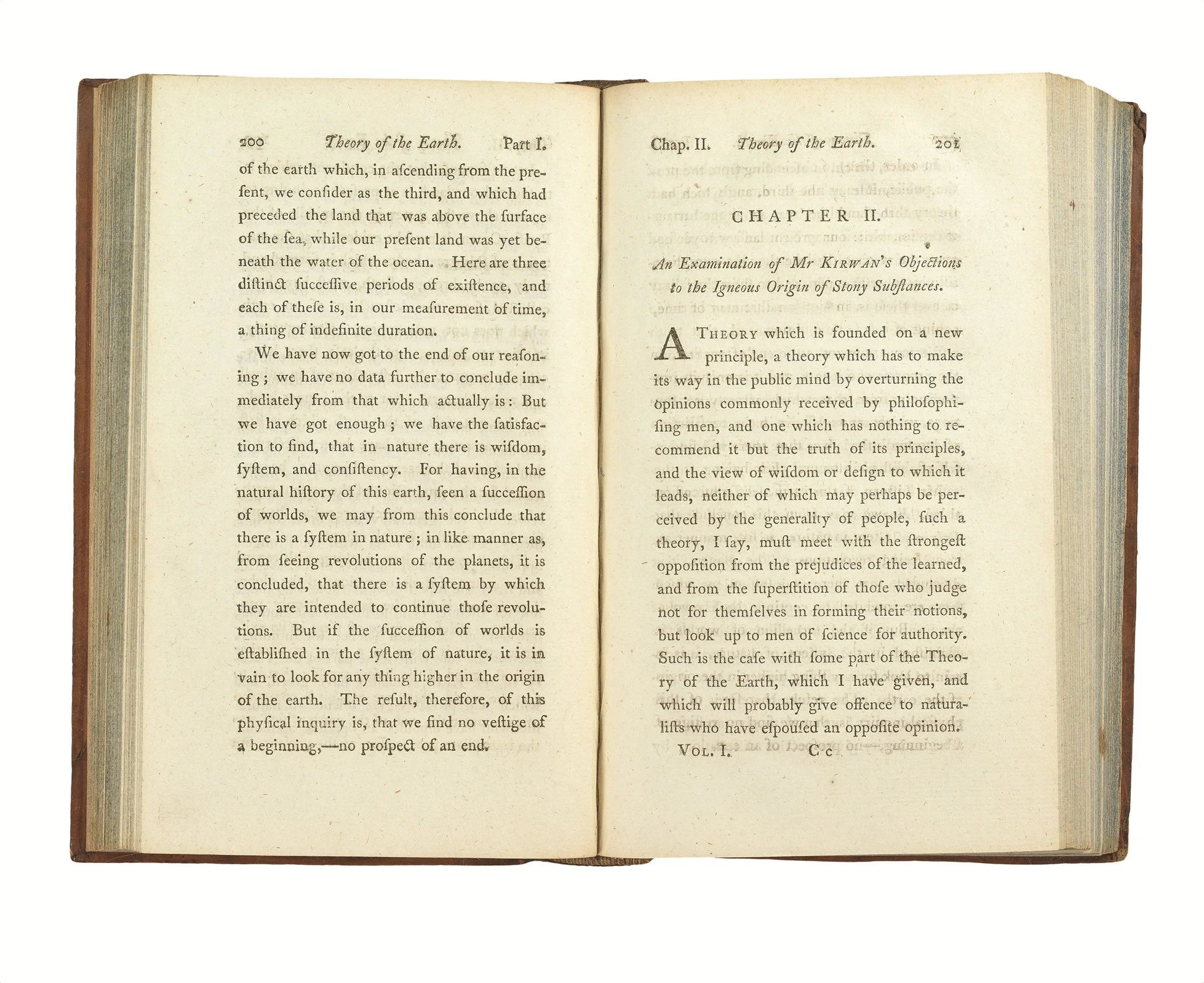 Image 2 of 3
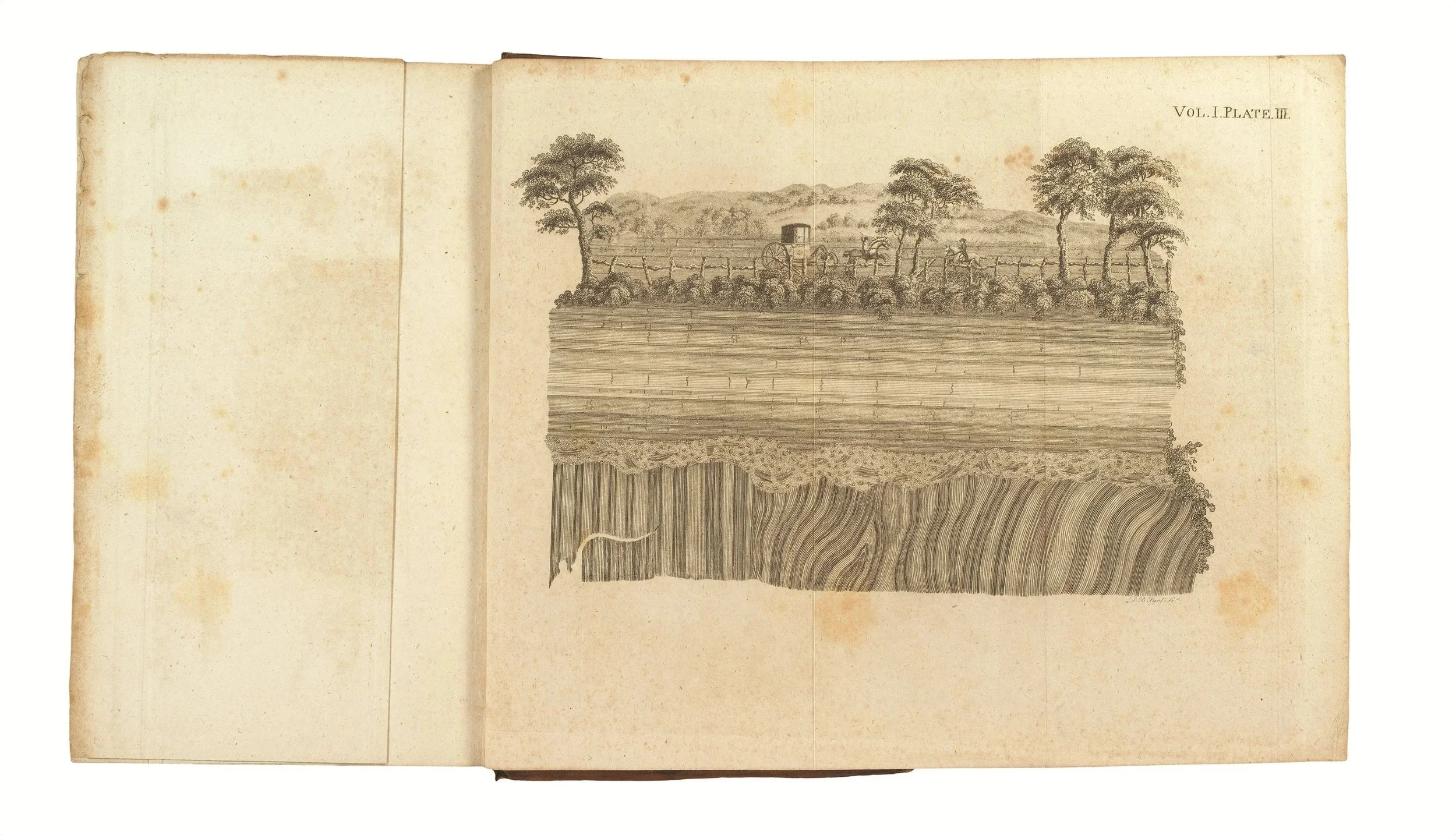 Image 3 of 3
HUTTON, James (1726-1797)
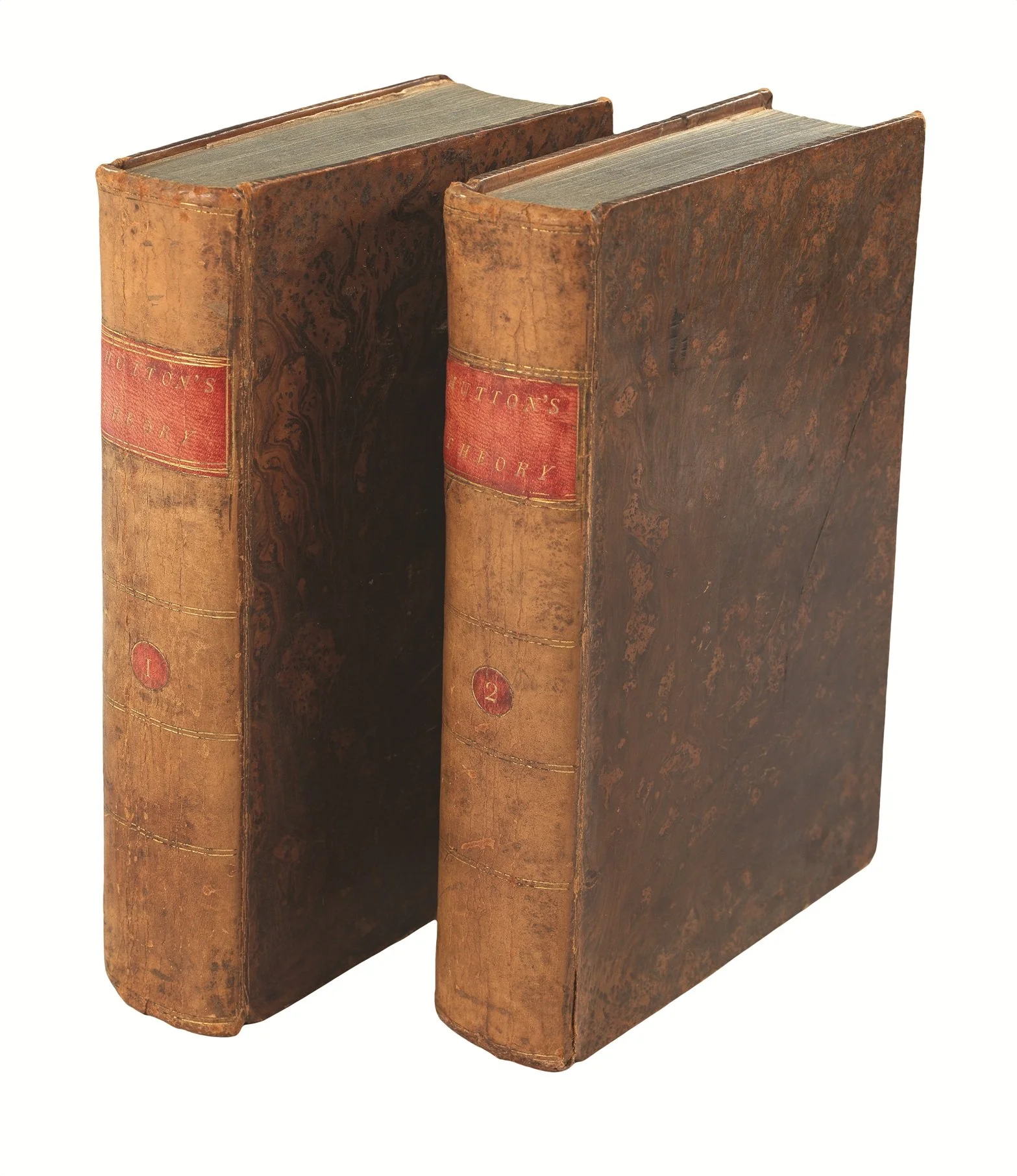
Theory of the Earth, with proofs and illustrations. Edinburgh: Cadell, Junior, and Davies, London, William Creech, Edinburgh, 1795 and 1899.
First edition of Hutton’s most important work, one of the greatest contributions to the science of geology, notably introducing the concept of deep time, the doctrine of uniformitarianism and the anti-Wernerian formation of igneous rocks. Moreover, the present work contains a radical statement of the geological cycle and is the first attempt at what might be termed systematic geology’. This copy is complete with the original two volumes (Edinburgh, 1795) in excellent condition in fine contemporary bindings as well as with Sir Archibald Geikie’s Geological Society edition of the posthumous third part (1899), based on Hutton’s unfinished six‑chapter manuscript, in the publisher's original wrappers.
The first chapter is a reprint of Hutton's 1788 famous paper originally published in vol. I of Transactions of the Royal Society of Edinburgh. As Challinor notes (pp.69-70), although the original paper contained much of Hutton's greatest contributions to the science of geology, it was the expansion of Hutton's theory using extensive factual material in this two-volume work that makes the present book so important. ‘In perusing these volumes the reader is relieved to come across Hutton's graphic descriptions of particulars with the direct generalisations he makes from them, as they are admirably graphic and to the point’ (Challinor p.70).
It is also Hutton's pre-occupation with field work that means that his 1795 publication is one of the earliest books to contain the empirical evidence for such important discoveries as uncomformity. ‘Hutton... found three uncomformities in southern Scotland. The first was that in the Isle of Arran (Lower Carboniferous on Dalradian), where an unconformity is obvious but the actual plane deceptive; the second (Old Red Sandstone on Silurian) was in the valley of the Jed... the third was at Siccar Point on the Berwickshire coast, also with Old Red Sandstone resting on Silurian’ (Challinor p. 74). ‘Hutton and Playfair realised that if they could find clear cases of structural unconformable relationship, representing a considerable time gap, between two groups of stratified rocks, this would be the surest evidence they could get to confirm the validity of Hutton's main thesis, what we usually now call the “geological cycle” or “geostrophic cycle”’ (Challinor p.74).
One of the reasons why Hutton included this field work was to deal effectively with the criticism that Richard Kirwan poured upon Hutton's theories in his paper Examination of the supposed igneous origin of stony substances presented to the Royal Irish Academy in 1793. Indeed, it was this criticism that forced Hutton into expanding his 1788 paper into the present book form so many years later. Hutton spends the entire second chapter rebutting Kirwan's criticisms point by point, tackling issues of degeneration and renewal, theistic world design, composition of granite and the existence of subterranean heat.
Hutton cites Deluc as evidence for the existence of river erosion (p.206 ff. & II,2), and it is interesting to note that in the present work, Hutton refers to another Continental geologist, Saussure. Both plates in the second volume are views of Mont Blanc taken directly from Saussure's Voyages. Both, of course, took Neptunist stances, with Deluc's 16pp. anonymous review of Theory in the British Critic in October 1796 being the amongst the fiercest. Nevertheless, Hutton was prepared to use their impartial observations as evidence backing his hypotheses. Vol. II, chapters 3 and 4 give plenty of space to these two men as evidence of degradation through erosion by fluvial and glacial means, and as Dean points out, ‘No geological theorist was ever more insistent as to the ubiquity of erosion’ (p.74).
The book is rare in commerce with only 8 copies appearing at auction in the last 50 years (RBH / ABSA). Dean believes the Edinburgh edition ‘may have been smaller than two hundred’ (p.62). The title page states that the book is ‘In four parts’, but only a third part – present here – was published posthumously in 1899 by Sir Archibald Geikie using Hutton's unfinished manuscript of 6 chapters.
Challinor 47; Dean 1992 p.278; Horblit 52a; PMM 247; Ward & Carozzi 1163. ESTC T53063.
2 volumes, octavo in 4s (210 x 123mm). I: pp. viii (half-title, title, contents), 620, 4 folding engraved plates; II: viii (half-title, title, contents), 567, [1 (blank)], 2 folding engraved plates. Complete with the first edition of the third volume edited by Archibald Geikie and published by the Geological Society in 1899. (Front free endpaper in vol. I just coming loose, occasional faint insignificant scattered spotting and soiling, but nonetheless a superb clean, crisp copy, small tear to 3Z4 just affecting text.) First 2 vols bound in contemporary (Scottish?) tree calf, flat spines, compartments ruled in gilt, red morocco gilt label in second compartments, small circular red morocco gilt volume number labels in fourth compartments, blue speckled edges (very slight creasing to spines, with a very small splits in tail caps of both vols expertly repaired, large natural flaw to leather on lower board of vol. 2 which is not disfiguring); vol. III bound in the original wraps, uncut (fractionally soiled, rear wrapper slightly frayed).
Provenance: Contemporary ink classmarks to front pastedowns – Maggs Bros (pencilled stock numbers and cost code on rear pastedown of vol. I) – Geoffrey Walton (bookplates).